It happens every year. I get going on the garden and everything else goes by the wayside. Here's a little update on what's been happening here at The Slice.
Onion plants
After trying to start onion seeds and wasting three packages of seeds in the process, this is what I have. One onion. I hope it gets big enough to eat. I had ordered a bunch of onion plants online, I was sorely disappointed in what I got in the mail. But, I planted them anyway. A lot of them seem to be doing okay in spite of their spindliness at the beginning. Good thing my neighbor gave me the rest of his sweet onion sets. They're growing really well.
Watermelon radishes
Germination was iffy at best for me this spring. Every last one that did start to grow almost immediately bolted and set seed. I will try again in my fall garden.
Cabbages
Holy cow have they been growing like mad! I discovered that one of the cabbages I bought is actually a cauliflower, but what the heck? Let's see how this turns out. The broccoli, cauliflower, and brussels sprouts are all doing very well.
Sweet potatoes
Following the disasterous results of the first attempt at growing sweet potato slips, I tried again with a new potato and got some very small slips. They were really tiny so I just planted the whole potato in the pot. We shall see what happens. I also bought a couple plants at a local garden center as well as some mail order slips. I was deeply disappointed in the slips when they arrived. But, I planted them anyway and more than half of them have new growth. If I actually get enough sweet potatoes, I plan to try canning them this fall.
Okra
The okra was a last minute addition to the garden plot this year. I impulse bought a fifty cent pack of seeds at the local dollar store. I think every last one of them came up. I don't even know if I like okra. Guess I'm going to find out.
Chamoe
Chamoe is also called Korean melon. I totally blame Hollis for this one. I ordered the seeds and planted them out about 10 days ago. These are the babies.
Infrastructure
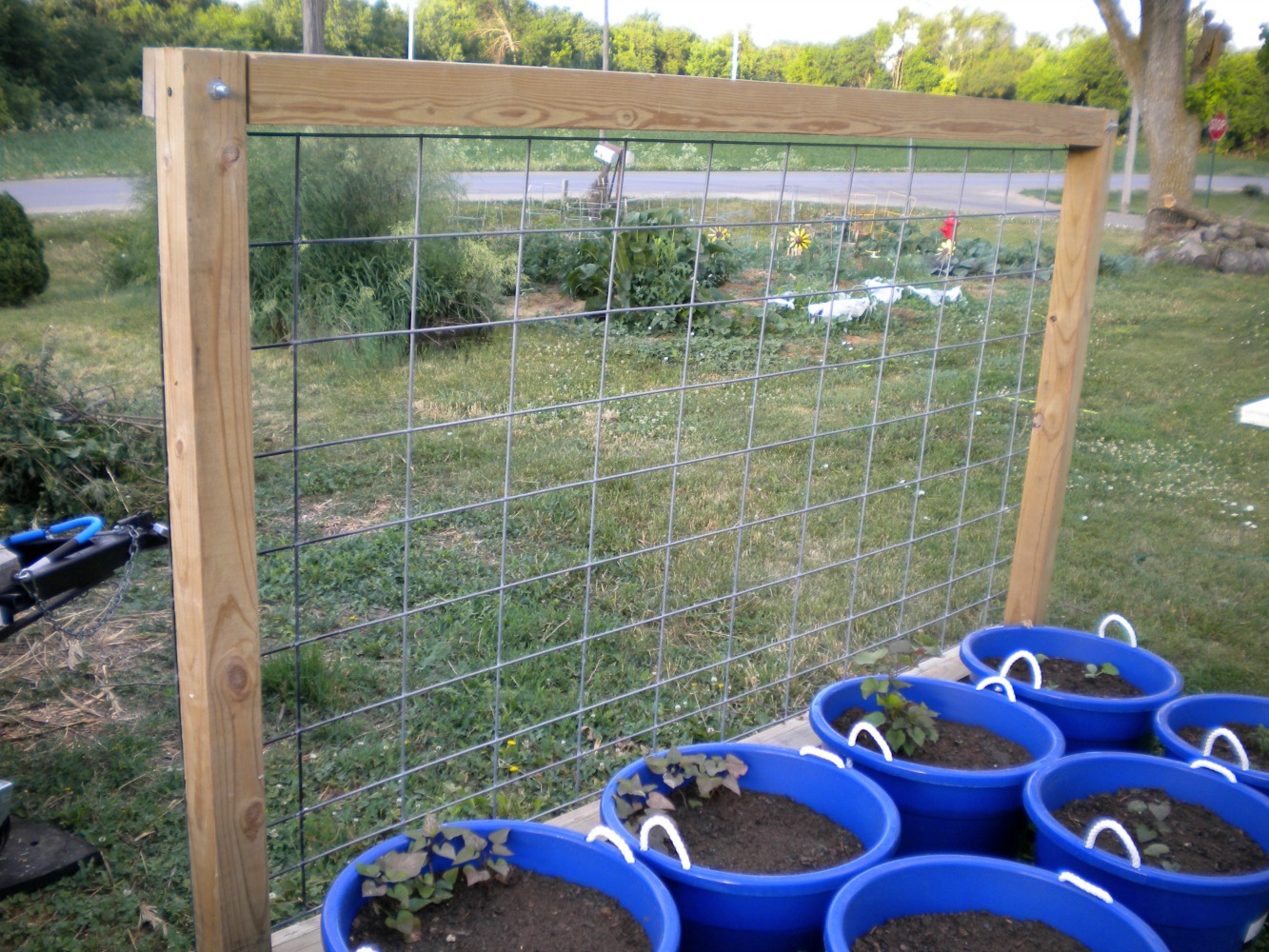
My hubby built a new trellis. By the time it was done, most my vining crops had been planted elsewhere. So I plan to train whatever sweet potato vines I get if I get any at all. I also planted a few Sweet Dumpling squashes in the farthest pot. They will probably climb the trellis all by themselves.
Eggplant
Other than a little flea beetle damage and a healthy coating of weeds, the eggplants seem to be doing just fine. I planted three varieties...maybe four...and they're all growing well and fixin' to flower soon. I tried an eggplant recipe that a friend cooked for me last week and it was edible. It is my goal in life this year is to find an eggplant recipe that I like. We shall see if my hopes are in vain or not.
Tomatoes
My beefsteak plants have set their first greenies. The Homestead plants were first to the mark this year and I noticed some Romas today as well. The plants are looking fabulous. I added some 'Jubilee' tomatoes that I impulse bought. They're orange tomatoes and I love them.
Squashes
I have severely curtailed my squash planting habits this year. I've planted only delitica, sweet dumpling, black beauty zucchini, and yellow crookneck. Above is an image of my delitica seedlings which were ALREADY being menaced by the evil and dastardly squash vine borer just today! Blasted things anyway. My plants are small on purpose to hopefully avoid infestation. We shall see how it goes. I'm hoping to avoid the use of the dreaded garden dust. But, I will if I have to. I've also found a few squash volunteers from last year's plantings. I've decided to let them grow and see what I get. And maybe the vine borers will menace the volunteers instead.
Melons
In addition to the chamoe melons, I have Sugar Baby watermelons and Minnesota Midget cantaloupes. This picture is the watermelons. The cantaloupes have only just sprouted in the last couple days. Hoping for some juicy melons this summer.
Well, that's about it. See you later!
Showing posts with label squash. Show all posts
Monday, June 19, 2017
Saturday, September 17, 2016
Late Summer Update from Picofarm
This year I decided to try a bunch of different kinds of tomatoes and do an informal study. There were 17 varieties all together. Here I present my determinations:
Here we have the red Rutgers, the small orange Zlatava (a Russian variety) at the bottom, the big yellow on the left with the red blush is called Mr. Stripey, and the other yellow is Yellow Oxheart. After extensive study in our test kitchens, we have determined the following:
Rutgers is best used in canning. Well, duh. It was sort of developed for that purpose. It's not a bad slicing tomato, but it's not very big. It is also fine in salads.
Although it did not perform as I expected, Zlatava makes a very nice salad tomato. Tasty and sweet but not too sweet. It's not a cherry tomato. I would grow this one again just for salads. Zlatava was touted as a large yellow tomato with a pink interior. The images that accompanied the seeds showed a tomato cut in half that resembled a pink grapefruit. Not so much. But it's so tasty I don't really care.
Mr. Stripey really shines in a BLT. It's not as 'tomatoey' as some I've had, but it's quite tasty with the bacon. It is reminiscent of a beefsteak but not as watery, I thought. Given my choice between Mr. Stripey and a beefsteak for my BLT, I'd choose Mr. Stripey. For some reason, my Mr. Stripey tomatoes don't look a lot like the picture on the plant ID tag. I'm not complaining. They're wonderful.
The Yellow Oxheart is just good eating. It seems like it is lower acid than a run-of-the-mill red tomato, but I haven't done a side-by-side comparison or any pH testing on which to base my conclusions.
Some varieties not pictured are San Marzano and La Roma. Both are paste types that performed as expected when prepared for sauce. I would not recommend them for eating on a salad as they are pretty dry. But they are perfect for saucing.
Black Krim. Never made it out of the garden. I ate the first one on the spot and after that they were all eaten the exact same way. Very, very tasty.
Black Prince. I did not get a single ripe tomato from the plant I got. It set a few fruit and then just stalled. I keep waiting and hoping...
Pink Brandywine. A very pretty heirloom type that the grasshoppers and birds seem to LOVE. I've only gotten a couple of unblemished fruits.
Green Pineapple. Very odd looking and because of the green color, I missed the first few fruits and they rotted on the vine. Sweet and tomatoey with rather delicate and easily bruised flesh. Really good on a plate with some salt.
Of course we had some Beefsteaks. Good old dependable beefsteak types are the best in sandwiches and eaten fresh. These were no exception.
'Sun-Dried' tomatoes were a meaty, paste type that did not perform well. Only a few fruits set before the heat of the summer took the plant out.
'Champion' set a lot of small tomatoes that taste okay. Nothing special to me anyway. Sized about like the Zlatava but nowhere near as good. The plants are on the smaller side and might do well in limited space.
This year we did three varieties of 'cherry' type tomatoes.
Super Sweet 100 is an annual favorite at our house. One or two plants gives us way more tiny tomatoes than we can hope to eat. They are sweet and juicy and surprisingly easy to store when dehydrated. They make a nice topping for pizza or a mix in for casseroles, pasta, meatloaf, soap, etc.
I had never grown Yellow Pear before this year. I had tried a plant last year but it didn't make it to the fruit bearing stage before a blight took it out. So this year I got seeds and started a couple dozen plants with the hope that one of them would give me some tomatoes.
Holy crap.
None of them died. I have yellow pear tomatoes everywhere. That might not be such a bad deal if I actually liked how they taste. They are a very pretty little pear-shaped tomato with a lovely yellow/gold color and almost zero tomato taste. I dried a few to see how they will perform in recipes and I made some pickled tomatoes with a few. I hope to report back on those in a few weeks. Unless they get a stellar review from one of those uses, I won't be growing those again. Prolific? Yes. Edible? Yes. Desirable? Not so much. They made so many tomatoes that I live in fear of the multitudes of volunteer plants I'll have next year. Yikes.
The last of the tiny tomatoes is a golden cherry that I have since lost the variety name. I wish I hadn't. These are easily the best cherry tomatoes I've ever eaten in my life. Somewhere in that garden plot is the identification tag that came with the plant I bought. I will find it. In the meantime, I'm saving some seeds in the hope that at least one of them will be true to the variety.
In other news...
I am super pleased with my squash crop this year. Probably the best one I've ever had! I have to confess: I used some garden dust on the squash vines this year. The squash vine borer is a menace in my part of the country. I rarely ever get more than a couple of edible fruits no matter how many vines I plant. This year I used some judiciously applied chemical dust and had almost NO vine borer issues and the squash bugs are almost non-existent. I know, I know...it's not organic. It's really a topic for another blog, but I'll just say here that it is very unlikely I will be able to grow completely organically in my plots no matter how carefully I shun the chemicals.
In the 'just for fun' section of the garden we find me and my broom corn. Just for scale, I am about 5'9" and the tallest of the broom corn is easily double my height. This was so much fun to watch as it grew like crazy to form the seed heads at the top. Last week I harvested those seed heads and I hope to make some nice fall decorations with them. I plan to make room for some broom corn every year. It's fun to grow and the seed heads turn brown and purple in the fall. I'll post up some pics of whatever I figure out to make with the seed heads.
A parting shot of the squash beds and the Bitch of a Ditch. I had hoped that the squash would grow down into the ditch eliminating the need to mow it all the dang time. It sort of did that. Next time I'll plant right along the edge and see what it does. Yep, that's little ol' me standing in the ditch for scale. I told you it's one big ditch.
That's all for now. I gotta get back out there and pick some peppers. There are lots of those to talk about, too. Until next time.
Thursday, July 16, 2015
Season of Change
A couple of days ago my position at work was eliminated. I knew it was coming months ago. I have had a plan in place to make the transition as painless as I possibly can for a long time now. I have lined up a part time job that starts this weekend and will become full time in the near future. It seems I've managed to keep my affairs in order.
Still, it stings a bit to be told you're no longer needed in a job you've done, and done well, for the last 16 years. So I've been feeling a bit sorry for myself these last weeks and especially the last couple of days. I admit to spending a bit of time not quite certain what I ought to be doing consumed with an empty, nagging feeling that I've forgotten...something.
It seems I've always had something to do.
It's not that I don't have anything to do. Perish the thought! It's just that my routine is disrupted. The things I had to do before are no longer on my to-do list. Things like getting up at the crack o' dawn to drive an hour and a half to work. Or like packing my lunch the night before and shopping for special lunch items that travel well and making sure I have something clean to wear to the office. It's really a pretty long list. I don't really miss that part so much.
No, the things I have to do now are simpler. Take out the trash. Wash the dishes. Cook some dinner. Mow the lawn. Putter in the garden.
Ah! The garden. Now there's a change of scenery. So much happens so quickly in the short time we have our growing season here in the heartland.
I took some pictures.
The tomatoes are crazy tall.
New to my garden plot this year is the Indigo Rose tomato. A friend at the aforementioned job grew them last year and gave me a few to try. They were cute and tasty. These are still green, but when they're ripe, the bottom of the fruits will be red and the top will stay purple.
Just today I got my very first cherry tomato of the season. I don't have a picture of that tomato because it didn't make it 3 feet away from the plant before I chowed it down. But here are some its kin:
Right next to the tomatoes, whether I wanted it there or not, is a massive row of volunteer dill plants that are every bit as tall as the tomatoes. They even came up in a bucket of dirt I had nearby.
Speaking of volunteers, I have a few in the garden this year other than the dill. Here are the petunias:
Onion flowers are quite pretty, aren't they?
The garden is really going well in spite of the record amounts of rain we've had this year. Lots of the local farmers had to abandon hope of planting anything at all in some of their soggy fields. I'm fortunate in that I garden pretty much exclusively in raised beds. Minor flooding really isn't an issue.
After harvesting most of the potatoes and the last of the peas last weekend, I decided to plant some late crops. I put in these pole beans where the peas just finished up:
Beans are almost instant gratification seeds since they germinate so quickly. These yellow summer squash seedlings are coming up right where I dug the potatoes. They come up pretty quickly, too.
The cucumbers are not really a late crop for me, I just got them planted later than usual. I heard if you delay planting until after June first or so, the plants will do better and be more resistant to damage from insects. I hope so. Those cucumber beetles are a menace.
These are a bush variety that I've never grown before. The plants are still pretty small and I'm not sure how big they'll get in the end. Looking forward to cucumbers soon.
This year I was fortunate enough to harvest an adequate amount of black raspberries to make a whole pint jar of jam and still have enough fresh berries to snack on while I did the picking. Here's the plant with the spent canes removed. Those are the new canes that will bear next year. I learned recently that if you let the ends of those canes get so much as a whiff of the soil, they'll set roots and start a new plant. I have room for another bush, so I might just do that if I can get the plant to go where I want it to go.
The large daylillies in the front garden are going gangbusters this year. They look especially nice with the native bee balm right beside:
Today's blog closes with a parting shot of my latest garden toy. Yep, that's right. It's a tractor seat on wheels. Now I can sit and pick tomatoes in comfort and style. Just don't look when I try to scoot around the beds on that thing. It's not a pretty sight.
Have a good one!
Still, it stings a bit to be told you're no longer needed in a job you've done, and done well, for the last 16 years. So I've been feeling a bit sorry for myself these last weeks and especially the last couple of days. I admit to spending a bit of time not quite certain what I ought to be doing consumed with an empty, nagging feeling that I've forgotten...something.
It seems I've always had something to do.
It's not that I don't have anything to do. Perish the thought! It's just that my routine is disrupted. The things I had to do before are no longer on my to-do list. Things like getting up at the crack o' dawn to drive an hour and a half to work. Or like packing my lunch the night before and shopping for special lunch items that travel well and making sure I have something clean to wear to the office. It's really a pretty long list. I don't really miss that part so much.
No, the things I have to do now are simpler. Take out the trash. Wash the dishes. Cook some dinner. Mow the lawn. Putter in the garden.
Ah! The garden. Now there's a change of scenery. So much happens so quickly in the short time we have our growing season here in the heartland.
I took some pictures.
The tomatoes are crazy tall.
New to my garden plot this year is the Indigo Rose tomato. A friend at the aforementioned job grew them last year and gave me a few to try. They were cute and tasty. These are still green, but when they're ripe, the bottom of the fruits will be red and the top will stay purple.
Just today I got my very first cherry tomato of the season. I don't have a picture of that tomato because it didn't make it 3 feet away from the plant before I chowed it down. But here are some its kin:
Right next to the tomatoes, whether I wanted it there or not, is a massive row of volunteer dill plants that are every bit as tall as the tomatoes. They even came up in a bucket of dirt I had nearby.
Speaking of volunteers, I have a few in the garden this year other than the dill. Here are the petunias:
The petunias I plant on purpose never look that good!
There are, of course, sunflowers:
And these brown-eyed susans and catmint:
And let's not forget this onion that I missed pulling last summer:
The garden is really going well in spite of the record amounts of rain we've had this year. Lots of the local farmers had to abandon hope of planting anything at all in some of their soggy fields. I'm fortunate in that I garden pretty much exclusively in raised beds. Minor flooding really isn't an issue.
After harvesting most of the potatoes and the last of the peas last weekend, I decided to plant some late crops. I put in these pole beans where the peas just finished up:
Beans are almost instant gratification seeds since they germinate so quickly. These yellow summer squash seedlings are coming up right where I dug the potatoes. They come up pretty quickly, too.
The cucumbers are not really a late crop for me, I just got them planted later than usual. I heard if you delay planting until after June first or so, the plants will do better and be more resistant to damage from insects. I hope so. Those cucumber beetles are a menace.
These are a bush variety that I've never grown before. The plants are still pretty small and I'm not sure how big they'll get in the end. Looking forward to cucumbers soon.
This year I was fortunate enough to harvest an adequate amount of black raspberries to make a whole pint jar of jam and still have enough fresh berries to snack on while I did the picking. Here's the plant with the spent canes removed. Those are the new canes that will bear next year. I learned recently that if you let the ends of those canes get so much as a whiff of the soil, they'll set roots and start a new plant. I have room for another bush, so I might just do that if I can get the plant to go where I want it to go.
The large daylillies in the front garden are going gangbusters this year. They look especially nice with the native bee balm right beside:
Today's blog closes with a parting shot of my latest garden toy. Yep, that's right. It's a tractor seat on wheels. Now I can sit and pick tomatoes in comfort and style. Just don't look when I try to scoot around the beds on that thing. It's not a pretty sight.
Have a good one!
Tuesday, March 12, 2013
Plan of Attack: Growing Squashes and Smiting the Squash Vine Borer (Updated!)
All my talk of luffa gourds last night has me thinking about growing squashes this year. I have a longstanding love for squash of all kinds so there is never really a question of whether or not I'm actually going to grow squash. The question is more often which types and how much.
Last year was a bust. The squash vine borers got every last one of my squash plants and my replacement seeds did not do well in the severe drought even with extra coddling and care. That's why there are so few pictures to accompany this blog post.
It was, in a word, disappointing. But this year will be different. I have a plan. <insert hand wringing and maniacal laughter here>
Over the last few weeks, I've done some online research about squashes and the pests that love them. I Googled squash vine borer and got over 94,000 results. That should give some indication of the severity of the problem this little clear-wing, day-flying moth causes every year.
But, as I said, I have a plan. I have more than one plan, actually. First and foremost, I plan to grow some varieties that have a natural immunity to the borers. I've read conflicting information about genetic resistance. I understand that Butternuts are the first choice for resistant varieties. For summer squashes planting the non-bush types should help. I found this information sheet on the topic in one of my many searches. Also, this forum thread was very interesting.
Before I start, let me just say that I am determined to make this work. I plan to make this as difficult as possible for the borers. If I have to plant in containers using fresh, sterilized soil every year then so be it. Based on the information gleaned here are my plans:
1. The first plan involves a yet-to-be constructed cover that I plan to put over my squash seeds from day one immediately following planting. The goal is to keep the borers from having any access at all to the plants until after the egg-laying portion of the annual cycle is over and done with. From what I've read, putting a floating row cover over top of your squash plants until the female flowers appear is one way to keep the borers at bay. If you're just not sure they're gone yet, you can even hand-pollinate the flowers until you're sure the coast is clear. I have an idea on how to make the covers sturdy enough to keep out the moths and big enough to allow the vines to grow undisturbed. I may do a tutorial on the construction process. I have more than one design in mind. I think this should work pretty effectively unless there are borer moths waiting in the soil where the squashes are planted. As further insurance, I plan to spray regularly with insecticidal soap. If these efforts should prove futile:
2. Two words: diatomaceous earth. Another article I found described how one gardener put a heap of diatomaceous earth around the base of all of his squash plants. Diatomaceous earth works to kill grubs, worms and other soft-bodied critters by being sharp enough to cut through their skin causing them to dehydrate and die. So as the eggs hatch and the grubs emerge, they crawl through the stuff and thus seal their own fates. It is totally natural and non-poisonous although I'm told you don't want to inhale the stuff and get it down into your lungs. That sounds icky. Yes, it's a technical term.
3. Bacillus thuringiensis, a.k.a. Bt, is a bacterium commonly used as a pesticide. It produces a crystal protein that affects the digestive tract of insects and causes them to die. Unfortunately, it is not specific to grubs or worms so it takes a bit more work to protect beneficial species than just spraying it on the plant. Another article I read suggested that a solution containing Bt should be injected into the affected plants to target and kill the grub that is destroying the squash vine. I see this as a second to last resort in my squash vine borer arsenal. But I'm not above it. I'm not, I tell you.
4. I've read some good things about Montery Spinosad Organic Garden Insect Spray. It's supposed to be very good at killing things like grubs, beetles and weevils butnot harming beneficial insects like bees. (update 28 June 2013: I have since learned that this is not the case. It says right on the label not to spray on or near flowering plants as the bees will be killed. Bummer.) I have not personally used this product. But if worse comes to worst, I will try it by spraying on the base of the plant near the ground. One article suggested that this could also be injected into the stem of the vine to target and kill the grub within. Another article touted its curative abilities in the squash bug arena.
5. If none of those things works this year, then I guess I'll just have to buy from someone who had better luck than I did. Last fall I ran across a guy at the farmer's market with a 16-foot trailer LOADED with butternut squashes. He said he had over a ton of squashes on the trailer and he had that many more waiting at home. He was selling them for $1 apiece and I felt like I was robbing him since the squashes in the store were almost twice that much per pound. But he practically begged me to take them. So I did.
Does all of this seem a little too much for some squashes? Perhaps it is. But at this point, it's the principle of the thing.
Last year was a bust. The squash vine borers got every last one of my squash plants and my replacement seeds did not do well in the severe drought even with extra coddling and care. That's why there are so few pictures to accompany this blog post.
| First wave of dying squash vines and their soon to be dead replacements. |
It was, in a word, disappointing. But this year will be different. I have a plan. <insert hand wringing and maniacal laughter here>
Over the last few weeks, I've done some online research about squashes and the pests that love them. I Googled squash vine borer and got over 94,000 results. That should give some indication of the severity of the problem this little clear-wing, day-flying moth causes every year.
But, as I said, I have a plan. I have more than one plan, actually. First and foremost, I plan to grow some varieties that have a natural immunity to the borers. I've read conflicting information about genetic resistance. I understand that Butternuts are the first choice for resistant varieties. For summer squashes planting the non-bush types should help. I found this information sheet on the topic in one of my many searches. Also, this forum thread was very interesting.
Before I start, let me just say that I am determined to make this work. I plan to make this as difficult as possible for the borers. If I have to plant in containers using fresh, sterilized soil every year then so be it. Based on the information gleaned here are my plans:
1. The first plan involves a yet-to-be constructed cover that I plan to put over my squash seeds from day one immediately following planting. The goal is to keep the borers from having any access at all to the plants until after the egg-laying portion of the annual cycle is over and done with. From what I've read, putting a floating row cover over top of your squash plants until the female flowers appear is one way to keep the borers at bay. If you're just not sure they're gone yet, you can even hand-pollinate the flowers until you're sure the coast is clear. I have an idea on how to make the covers sturdy enough to keep out the moths and big enough to allow the vines to grow undisturbed. I may do a tutorial on the construction process. I have more than one design in mind. I think this should work pretty effectively unless there are borer moths waiting in the soil where the squashes are planted. As further insurance, I plan to spray regularly with insecticidal soap. If these efforts should prove futile:
2. Two words: diatomaceous earth. Another article I found described how one gardener put a heap of diatomaceous earth around the base of all of his squash plants. Diatomaceous earth works to kill grubs, worms and other soft-bodied critters by being sharp enough to cut through their skin causing them to dehydrate and die. So as the eggs hatch and the grubs emerge, they crawl through the stuff and thus seal their own fates. It is totally natural and non-poisonous although I'm told you don't want to inhale the stuff and get it down into your lungs. That sounds icky. Yes, it's a technical term.
3. Bacillus thuringiensis, a.k.a. Bt, is a bacterium commonly used as a pesticide. It produces a crystal protein that affects the digestive tract of insects and causes them to die. Unfortunately, it is not specific to grubs or worms so it takes a bit more work to protect beneficial species than just spraying it on the plant. Another article I read suggested that a solution containing Bt should be injected into the affected plants to target and kill the grub that is destroying the squash vine. I see this as a second to last resort in my squash vine borer arsenal. But I'm not above it. I'm not, I tell you.
4. I've read some good things about Montery Spinosad Organic Garden Insect Spray. It's supposed to be very good at killing things like grubs, beetles and weevils but
5. If none of those things works this year, then I guess I'll just have to buy from someone who had better luck than I did. Last fall I ran across a guy at the farmer's market with a 16-foot trailer LOADED with butternut squashes. He said he had over a ton of squashes on the trailer and he had that many more waiting at home. He was selling them for $1 apiece and I felt like I was robbing him since the squashes in the store were almost twice that much per pound. But he practically begged me to take them. So I did.
Does all of this seem a little too much for some squashes? Perhaps it is. But at this point, it's the principle of the thing.
Thursday, July 12, 2012
AAAUUUGGGHHHH! Blog Episode One: The Squash Vine Borer
I suppose it had to happen sooner or later. This gardening season was going very nicely. No major problems except for the odd little weevils that attacked, skeletonized and destroyed the mustard greens in my mesclun salad mix. It was ONLY the mustard greens. Apparently, we have very discriminating weevils in Nebraska. Who knew?
I dislike the mustard greens anyway, so no biggie to me.
But this. This is unacceptable.
I stepped out to the garden to water the plants in pots and examine the tomatoes for peak ripeness. That's when I noticed the squash plants didn't look right. By 'right' I mean they didn't look green and upright. In fact, they looked downright yellow and wilty.
So I grabbed the hose and, as I started watering, wondered how on earth I could have missed them yesterday. Upon closer examination, the truth was revealed: tiny, itty, bitty little sawdust-y holes at the base of some of the vines.
Squash vine borers! AAAUUUGGHHHH! I almost choked on my gum.
After a few moments of impolite comment, I reluctantly pulled out the vines that looked the worst and examined the remaining plants for holes. Not all of the vines were affected and, after some research, I concluded that they must be the butternut squashes I planted. Butternuts, for some reason, seem to be less affected by the borers. I'm still working on my seedling labeling skills so I'm not really sure which varieties are still alive.
Here's what I learned about the borers today: Squash vine borers overwinter in the ground as pupae and emerge in the summertime as adult, clearwing moths whereupon they set out in search of a likely looking squash plant on which to mate and lay eggs. When the eggs hatch, the little larva bore into the vines and take up residence inside the stem blocking the flow of water and nutrients to the plant which eventually dies. Once the larva matures, it digs down into the ground to pupate so it can emerge next year to ruin someone else's squash plants.
Lovely.
Organic controls of the squash vine borer are aimed more or less at prevention rather than destruction. Basically, the idea is to exclude the adult moths from your baby vines. This is best accomplished by learning to identify the adult moths and then, once you spy them buzzing around, using floating row covers or another mesh type barrier with tiny holes to keep the adults from laying their eggs on your plants. The eggs are most likely to be laid during the second half of June or so in my neck of the woods so putting up the covers for a few weeks during June and July should do the trick.
If you really want to try to save the affected plants you have, there is one thing you can try. Sterilize a sharp knife and use it to slit the stem of the affected vine upward starting at the point where the larva bored into the stem. When you locate the larva (or larvae), stab the heck out of it/them with the knife. Then carefully reposition the vine and bury the cut portion in the garden with dirt and keep it moist. With luck, the vine will put down more roots where it is buried and the plant may live. Then again, you might wind up with a dead squash plant buried neck deep in your garden.
Fortunately for you and me, the borers only have the one generation every year. So, chances are they have probably done the damage they were going to do already. It's going to be close, but I think I can set out another planting of seed and maybe get a few squashes before winter sets in. The seed packets all say 95-105 days to maturity and I have right about that many days until first average frost. I have nothing to lose but the rest of my squash seeds, right?
At least next year, I'll be ready for them. The little...darlings!
I dislike the mustard greens anyway, so no biggie to me.
But this. This is unacceptable.
I stepped out to the garden to water the plants in pots and examine the tomatoes for peak ripeness. That's when I noticed the squash plants didn't look right. By 'right' I mean they didn't look green and upright. In fact, they looked downright yellow and wilty.
So I grabbed the hose and, as I started watering, wondered how on earth I could have missed them yesterday. Upon closer examination, the truth was revealed: tiny, itty, bitty little sawdust-y holes at the base of some of the vines.
Squash vine borers! AAAUUUGGHHHH! I almost choked on my gum.
After a few moments of impolite comment, I reluctantly pulled out the vines that looked the worst and examined the remaining plants for holes. Not all of the vines were affected and, after some research, I concluded that they must be the butternut squashes I planted. Butternuts, for some reason, seem to be less affected by the borers. I'm still working on my seedling labeling skills so I'm not really sure which varieties are still alive.
Here's what I learned about the borers today: Squash vine borers overwinter in the ground as pupae and emerge in the summertime as adult, clearwing moths whereupon they set out in search of a likely looking squash plant on which to mate and lay eggs. When the eggs hatch, the little larva bore into the vines and take up residence inside the stem blocking the flow of water and nutrients to the plant which eventually dies. Once the larva matures, it digs down into the ground to pupate so it can emerge next year to ruin someone else's squash plants.
Lovely.
Organic controls of the squash vine borer are aimed more or less at prevention rather than destruction. Basically, the idea is to exclude the adult moths from your baby vines. This is best accomplished by learning to identify the adult moths and then, once you spy them buzzing around, using floating row covers or another mesh type barrier with tiny holes to keep the adults from laying their eggs on your plants. The eggs are most likely to be laid during the second half of June or so in my neck of the woods so putting up the covers for a few weeks during June and July should do the trick.
If you really want to try to save the affected plants you have, there is one thing you can try. Sterilize a sharp knife and use it to slit the stem of the affected vine upward starting at the point where the larva bored into the stem. When you locate the larva (or larvae), stab the heck out of it/them with the knife. Then carefully reposition the vine and bury the cut portion in the garden with dirt and keep it moist. With luck, the vine will put down more roots where it is buried and the plant may live. Then again, you might wind up with a dead squash plant buried neck deep in your garden.
Fortunately for you and me, the borers only have the one generation every year. So, chances are they have probably done the damage they were going to do already. It's going to be close, but I think I can set out another planting of seed and maybe get a few squashes before winter sets in. The seed packets all say 95-105 days to maturity and I have right about that many days until first average frost. I have nothing to lose but the rest of my squash seeds, right?
At least next year, I'll be ready for them. The little...darlings!
Subscribe to:
Posts (Atom)